Overview
Link to section: OverviewThis document summarizes observations from Logs/AdminLogs.log, a macOS Unified Logging snapshot containing approximately four minutes of networking activity.
The log is primarily composed of:
- DNS resolution
- Apple service communication
- Content Delivery Network (CDN) routing
- iCloud Private Relay configuration
- Apple backend service metadata
- HTTP response headers
Network.frameworkevents
Rather than functioning primarily as a record of administrator actions, the supplied excerpt provides a detailed look at how macOS communicates with Apple's cloud and delivery infrastructure.
Executive Summary
Link to section: Executive SummaryThe logs reveal multiple layers of Apple's production networking architecture operating simultaneously.
Observed infrastructure includes:
- Apple CDN services
- Akamai edge infrastructure
- Apple Private Relay
- Cloudflare relay infrastructure
- Fastly relay infrastructure
- Apple's
Daiquiribackend - AWS-hosted Apple service-instance identifiers
- Kubernetes-hosted Apple service-instance identifiers
- QUIC / HTTP/3 proxy routing
- Privacy token authentication
- Apple News
- App Store services
- Apple Account Services
One of the most interesting observations is that Apple backend responses returned headers containing internal-looking routing and instance metadata.
Apple’s 2022 backend was exposing a fairly detailed hybrid cloud architecture through HTTP response headers, with Daiquiri fronting Kubernetes-hosted and AWS-hosted production service instances while macOS simultaneously maintained an Apple → Akamai/Cloudflare/Fastly privacy-relay architecture.
Direct observation vs. interpretation
Link to section: Direct observation vs. interpretation| Type | Finding |
|---|---|
| Direct observation | HTTP responses identify daiquiri/3.0.0. |
| Direct observation | x-daiquiri-instance contains both ...kubernetes... and ...aws... identifiers. |
| Direct observation | Akamai cache infrastructure appears in x-cache and DNS resolution paths. |
| Direct observation | networkserviceproxy logs Akamai token generation, activation, caching, and QUIC token activity. |
| Direct observation | Private Relay configuration names Apple, Akamai, Cloudflare, and Fastly-related endpoints. |
| Interpretation | The combined evidence is consistent with a hybrid Apple backend and multi-provider privacy/CDN architecture. |
Overall Architecture
Link to section: Overall Architecture
This diagram combines two distinct classes of observations:
- Apple service responses exposing Daiquiri/backend instance metadata.
- Local privacy-proxy configuration exposing Apple ingress and third-party relay providers.
Apple Content Delivery Network (CDN)
Link to section: Apple Content Delivery Network (CDN)A significant portion of the log consists of DNS resolution involving Apple's CDN paths and Akamai edge infrastructure.
A representative resolution path is:
init.itunes.apple.com
        │
        ▼
init-cdn.itunes-apple.com.akadns.net
        │
        ▼
itunes.apple.com.edgekey.net
        │
        ▼
e673.dsce9.akamaiedge.net
        │
        ▼
Akamai edge IP
Conceptually:


This is consistent with Apple's use of Akamai's globally distributed edge infrastructure to serve content efficiently.
Key Observation
Link to section: Key ObservationApple service delivery in the log is not limited to direct Apple-owned endpoints. DNS aliases and response metadata show Akamai participating in the delivery path.
Apple → Akamai CDN → an Akamai edge server geographically/routing optimized for the client ISP connection.
That model explains why the log can contain a very large number of Akamai references without each reference representing an unrelated external service.
Raw evidence: Akamai cache + Daiquiri response metadata
Link to section: Raw evidence: Akamai cache + Daiquiri response metadataThe following panel is rendered from exact lines in AdminLogs.log. It shows an Akamai cache hit together with the Daiquiri server and instance headers returned in the same response block.
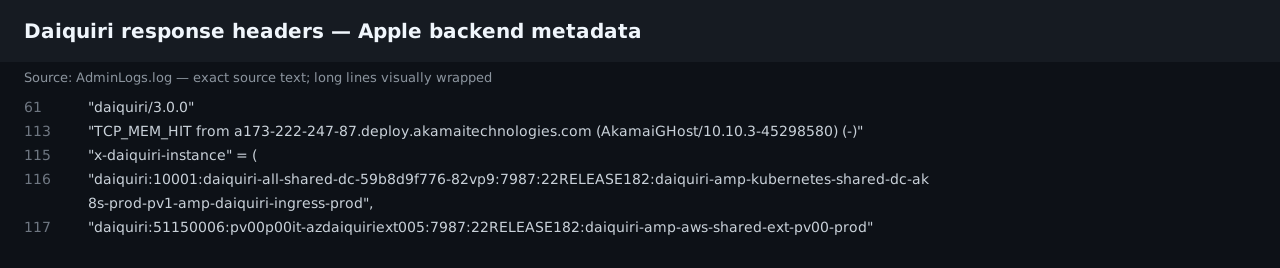
Observed directly:
daiquiri/3.0.0AkamaiGHost- an Akamai Technologies cache hostname
x-daiquiri-instance- a Kubernetes-labelled Daiquiri instance identifier
- an AWS-labelled Daiquiri instance identifier
Apple Private Relay
Link to section: Apple Private RelayOne of the clearest infrastructure disclosures in the log is the configuration processed by macOS networkserviceproxy.
Observed domains include:
mask.icloud.com
mask-api.icloud.com
mask-h2.icloud.com
The configuration also includes:
enabled = 1;and identifies Apple plus several third-party relay/CDN providers.
Raw evidence: Private Relay configuration
Link to section: Raw evidence: Private Relay configuration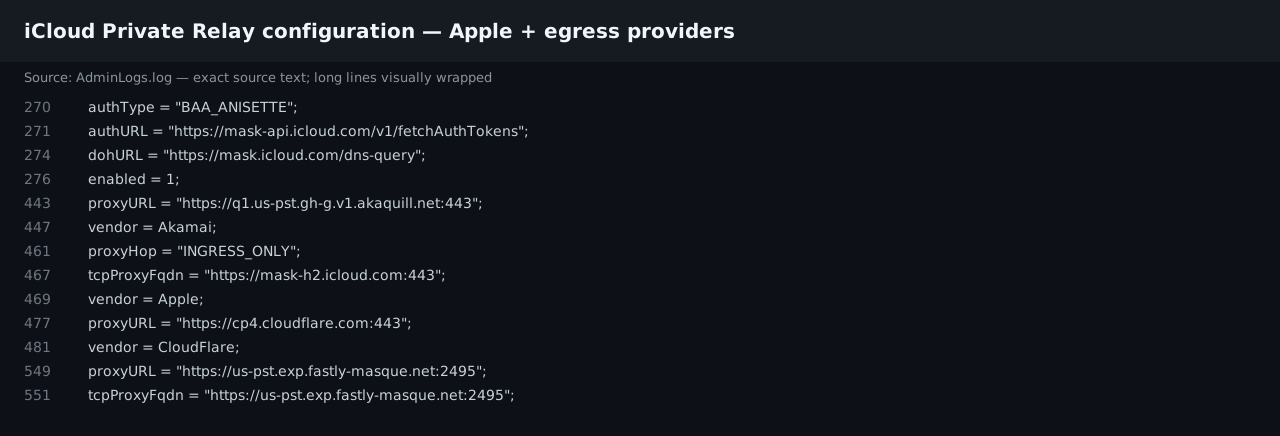
The excerpt directly shows:
authType = "BAA_ANISETTE"https://mask-api.icloud.com/v1/fetchAuthTokenshttps://mask.icloud.com/dns-queryenabled = 1- an Akamai endpoint under
akaquill.net vendor = AkamaiproxyHop = "INGRESS_ONLY"https://mask-h2.icloud.com:443vendor = Applehttps://cp4.cloudflare.com:443vendor = CloudFlare- Fastly MASQUE-related hostnames
These are direct log observations. The architecture diagram below is the interpretation built from those records.
Private Relay Topology
Link to section: Private Relay Topology
The log therefore exposes both the Apple-operated ingress side and multiple provider-specific paths associated with relay delivery.
Akamai Token Infrastructure
Link to section: Akamai Token InfrastructureOne of the most unusual-looking sections of the log involves Akamai-specific token handling by networkserviceproxy.
Examples include:
Registering Akamai token agent
generated 30 unactivated tokens for Akamai
Token for Quic[Akamai] fetch failed
activated 30 tokens for Akamai
Token fetch successful for "Akamai"
Cache 30 tokens for proxy "Akamai"
Raw evidence: Akamai token sequence
Link to section: Raw evidence: Akamai token sequence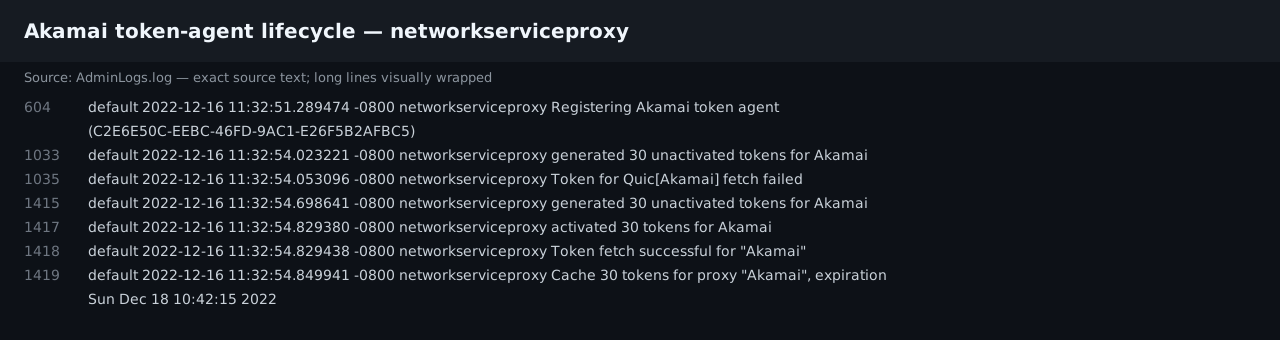
The timing is especially useful because the excerpt shows failure and recovery within the same short sequence.
The available context is consistent with these tokens being associated with Apple's privacy-proxy routing/authentication infrastructure rather than ordinary CDN object authentication.
Importantly, the isolated failure message is followed by successful token activation and caching, so the failure should be interpreted together with the subsequent recovery events.
QUIC / HTTP/3
Link to section: QUIC / HTTP/3The log explicitly references:
Token for Quic[Akamai]along with proxy-selection activity involving Akamai.
QUIC is the transport foundation used by HTTP/3 and is also relevant to modern proxying and MASQUE-style architectures.
A conceptual flow consistent with the log is:


The graph is an architectural interpretation; the Akamai QUIC-token messages themselves are directly present in the evidence panel above.
Daiquiri Backend
Link to section: Daiquiri BackendOne of the most revealing response blocks identifies Apple's backend server as:
daiquiri/3.0.0The same response contains:
x-daiquiri-instancewith instance identifiers that include both:
daiquiri-amp-kubernetes-shared-...and:
daiquiri-amp-aws-shared-...Raw evidence: Daiquiri hybrid backend identifiers
Link to section: Raw evidence: Daiquiri hybrid backend identifiersThe important finding is the coexistence of these labels in a response returned through an Apple service path. The log itself exposes the strings; describing them as backend routing/instance metadata is an interpretation based on their placement in the x-daiquiri-instance header.
Hybrid Cloud Architecture
Link to section: Hybrid Cloud ArchitectureThe response metadata can be modeled as:
This graph intentionally treats AWS-labelled and Kubernetes-labelled instances as parallel observations, not as proof that one necessarily runs inside the other.
The log demonstrates that both labels were returned in the backend instance metadata. Determining the precise provider/runtime nesting would require additional infrastructure evidence beyond this snapshot.
Apple Services Observed
Link to section: Apple Services ObservedThe supplied log contains activity associated with Apple service families including:
- Apple News
- App Store
- Account Services
- Advertising/privacy services
- Apple Maps/location-service configuration
- Apple CDN infrastructure
- Apple Private Relay
- Apple Media Services
- Network.framework
Representative process/service names visible in the larger log include:
mDNSResponder
networkserviceproxy
NewsToday2
adprivacyd
askpermissiond
amsaccountsd
appstoreagent
promotedcontentd
DNS Resolution
Link to section: DNS ResolutionA single user-visible service request can create many Unified Log records because DNS resolution is iterative and heavily instrumented.
Typical flow:


This helps explain why a relatively short capture window can contain a very large number of Akamai-related entries.
Cloud Providers Observed
Link to section: Cloud Providers ObservedThe log exposes two related but distinct infrastructure patterns.
1. Privacy / relay infrastructure
Link to section: 1. Privacy / relay infrastructure
2. Apple application/backend metadata
Link to section: 2. Apple application/backend metadata
These findings show multiple infrastructure vendors and execution environments appearing in the same short macOS networking snapshot.
They do not by themselves establish the exact contractual, physical, or virtualization relationship between every provider. What the evidence directly establishes is that these provider/environment identifiers are present in client-visible configuration and response metadata.
Technical Findings
Link to section: Technical FindingsApple CDN / Akamai
Link to section: Apple CDN / Akamai- Extensive Akamai edge and DNS routing appears in the log.
- Apple hostnames resolve through Akamai-related aliases and edge infrastructure.
- Response metadata includes
AkamaiGHostand an Akamai Technologies cache hostname. - Geographic/network-topology edge selection is consistent with standard CDN operation.
Private Relay
Link to section: Private RelayObserved in the configuration:
- Apple ingress-related endpoints
- Akamai provider path
- Cloudflare provider path
- Fastly/MASQUE-related path
- token authentication endpoint
- DNS-over-HTTPS bootstrap resolver
enabled = 1- QUIC-related token activity
Akamai Tokens
Link to section: Akamai TokensObserved lifecycle:
- token-agent registration
- token generation
- QUIC token fetch failure
- later token activation
- successful fetch
- caching of 30 Akamai tokens
Daiquiri
Link to section: DaiquiriObserved:
Server: daiquiri/3.0.0x-daiquiri-instance- detailed instance identifiers
- Kubernetes-labelled backend metadata
- AWS-labelled backend metadata
Cloud Infrastructure
Link to section: Cloud InfrastructureThe log contains direct references associated with:
- Apple
- Akamai
- AWS
- Kubernetes
- Cloudflare
- Fastly
Conclusions
Link to section: ConclusionsThe log provides a detailed snapshot of Apple's production networking ecosystem as it was exposed to a macOS client in December 2022.
Major observations include:
- Apple's extensive use of Akamai in CDN and edge-delivery paths.
- A multi-provider Private Relay configuration containing Apple, Akamai, Cloudflare, and Fastly-related infrastructure.
- Akamai-specific privacy/proxy token generation, QUIC token handling, activation, and caching inside
networkserviceproxy. - HTTP response headers exposing Apple's
Daiquiriserver identifier and detailedx-daiquiri-instancemetadata. - Backend identifiers referencing both AWS-labelled and Kubernetes-labelled production service instances.
- QUIC/HTTP3-related proxy behavior.
Taken together, the logs illustrate a distributed architecture combining Apple-operated services with multiple commercial infrastructure providers and backend environments.
The strongest concise finding is:
Apple’s 2022 backend was exposing a fairly detailed hybrid cloud architecture through HTTP response headers, with Daiquiri fronting Kubernetes-hosted and AWS-hosted production service instances while macOS simultaneously maintained an Apple → Akamai/Cloudflare/Fastly privacy-relay architecture.
Rather than showing isolated systems, the snapshot demonstrates how client networking, relay infrastructure, CDN providers, and Apple backend service platforms appeared together within a single macOS logging window.
Evidence Handling
Link to section: Evidence HandlingThis repository separates direct observation from interpretation wherever possible.
Direct observation
Link to section: Direct observationItems copied directly from the supplied logs include:
- hostnames
- process names
- HTTP response-header values
- proxy provider names
- timestamps
- token lifecycle messages
- Daiquiri instance identifiers
Interpretation
Link to section: InterpretationArchitecture diagrams and descriptions connect those observations into likely service relationships. These diagrams should not be treated as internal Apple design documentation.
For reproducible analysis, readers should compare each interpretation against the original source log:
Evidence panels
Link to section: Evidence panelsThe inline evidence panels are SVG renderings of exact source lines from AdminLogs.log; long lines are visually wrapped for readability. They are stored in:
evidence/
├── akamai-token-sequence.svg
├── daiquiri-hybrid-backend.svg
└── private-relay-configuration.svg
Related macOS installer research
Link to section: Related macOS installer researchmacOS Install Security Research is a separate partial build-25G83 investigation of macOS install data, recovery RAMDisks, ramrod, firmware, EFI, and boot/security boundaries. Its findings, evidence limits, and CC BY 4.0 license are documented in that repository; this report's MIT license and completion badge do not describe the separate investigation.
License
Link to section: LicenseThis research is released under the MIT License.