Overview
Link to section: OverviewIn Apple's unified device recovery model, a Software Update RAMDisk (SURamDisk) is an isolated, memory-resident operating system loaded by iBoot / BridgeOS during Device Firmware Upgrade (DFU) restores, factory refurbishing, and major macOS software updates.
The RAMDisk solves a fundamental chicken-and-egg problem:
- How does a machine flash corrupt or uninitialized onboard NAND storage controllers when it cannot safely boot from them?
- How does an updater establish an authenticated data bridge to a host Mac without standard network interfaces?
The StarSecurityRome21G115 environment operates entirely in physical RAM using AppleDiskImagesRAMBackingStore. It bundles an optimized Darwin kernel, hardware updaters for solid-state storage and power controllers, and Apple's unified ramrod restore engine to build and seal the final operating system image.
Executive Summary
Link to section: Executive SummaryThe artifact provides a complete window into Apple's bare-metal provisioning toolchain:
- Target Environment: macOS 12.6 Monterey (Build
21G115) onx86_64(Intel Macs with Apple T2 Security Chip). - Isolation Architecture: Single-stage interactive
/sbin/launchdenvironment without standard multi-user services (/Users,/Applications,/Library). - Restore Engine: Orchestrated by
/usr/libexec/ramrod/ramrodrunning theramrod-macos-patchd-plugin.ramroddynamic plugin. - Kernel & Driver Layer: Monolithic 65 MB
BootKernelExtensions.kcprelinking 252 kernel extensions covering NVMe, Thunderbolt, SMC, SEP, and crypto accelerators. - Firmware Repository: Built-in offline Option ROMs for Apple custom SSD controllers (
S4E,t302), USB-C Type-C High Performance Managers (USB-C_HPM), MegaChips DisplayPort bridges (MCDP29XX), and Secure Enclave (SLAM). - Cryptographic Sealing: Complete APFS maintenance suite (
apfs_sealvolume,apfs_checkseal,slurpAPFSMeta) for Merkle-tree snapshot generation.
Direct Observation vs. Interpretation
Link to section: Direct Observation vs. Interpretation| Type | Direct Finding | Technical Interpretation |
|---|---|---|
| Direct observation | SystemVersion.plist identifies ProductBuildVersion: 21G115, ReleaseType: Restore, and BridgeOSActivationSupported: YES. | Official Apple DFU recovery image built for macOS Monterey 12.6 and BridgeOS 15.7. |
| Direct observation | PurpleReverseProxy binds localhost TCP sockets on ports 1081 (socks), 1082 (ctrl), and 1084 (notify). | Employs loopback IPC bridged across USB muxing (usbmuxd) to communicate with Apple Configurator. |
| Direct observation | ramrod links patchd_macos_seal_system_volume and holds direct IOKit user-client entitlements (AppleNVMeUpdateUC, AppleSMCClient). | Bypasses standard OS file abstraction to execute raw block operations and Merkle-tree root hash generation. |
| Direct observation | /usr/standalone/firmware/ embeds raw binary Option ROMs for Samsung, Toshiba, SanDisk, and SK Hynix NAND flash arrays. | Self-contained recovery capability to re-flash bricked SSD controller microcode without an active network connection. |
| Direct observation | Image includes zero user directories, credentials, or transient logs. | Pure factory master template generated in a deterministic clean-room build environment. |
Overall Architecture
Link to section: Overall Architecture
Forensic & Cryptographic Identification
Link to section: Forensic & Cryptographic IdentificationImage Name: StarSecurityRome21G115.x86_64SURamDisk.dmg
Internal Label: StarSecurityRome21G115.x86_64SURamDisk
Release Type: Restore
Product Version: macOS 12.6 Monterey (Build 21G115)
BridgeOS Base: 15.7 (BridgeOSActivationSupported: YES)
Target Architecture: x86_64 (Mach-O 64-bit thin)
Image Format: Apple UDIF read-only compressed zlib (UDZO)
Partition Scheme: GUID Partition Table (GPT) / APFS Container
APFS Partition UUID: E2237814-AB68-4973-A672-41C1631AB21D
APFS Container UUID: 7C3457EF-0000-11AA-AA11-00306543ECACChecksums & Geometry
Link to section: Checksums & Geometry| Metric | Value |
|---|---|
| SHA-256 Checksum | d5e54a6d9d466db0f76818d29b0a7fa5d729c506fca62e3b5c5d6482ee68166d |
| MD5 Checksum | 0fe42a8b6f6fc23991253fb54dc16b01 |
| CRC32 Checksum | $11587BAC |
| Compressed Size | 159,780,108 bytes (~152.4 MB) |
| Uncompressed Size | 421,169,152 bytes (~401.7 MB) |
| Compression Ratio | 41.76% |
| Sector Count | 822,596 (512 bytes per sector) |
Boot & Init Subsystem
Link to section: Boot & Init SubsystemDaemon Manifests & Execution Graph
Link to section: Daemon Manifests & Execution GraphLocated in /System/Library/LaunchDaemons/, the runtime services operate under single-stage interactive rules:
/sbin/launchd: Executes as PID 1 directly from the RAM backing store.com.apple.ramrod.plist: Spawns/usr/libexec/ramrod/ramrodwithStandardOutPathandStandardErrorPathdirected to/dev/console.com.apple.diskimagesiod.ram.plist: Runs/usr/libexec/diskimagesiod --ramunder privilege-separated user_diskimagesiod(UID 271).com.apple.syslogd.plist: Provides system logging daemon with ASL disabled in favor of Darwin unified logging.
Raw Evidence: PurpleReverseProxy Socket Configuration
Link to section: Raw Evidence: PurpleReverseProxy Socket ConfigurationThe host-target communication bridge is defined in /System/Library/LaunchDaemons/com.apple.PurpleReverseProxy.ramdisk.plist.
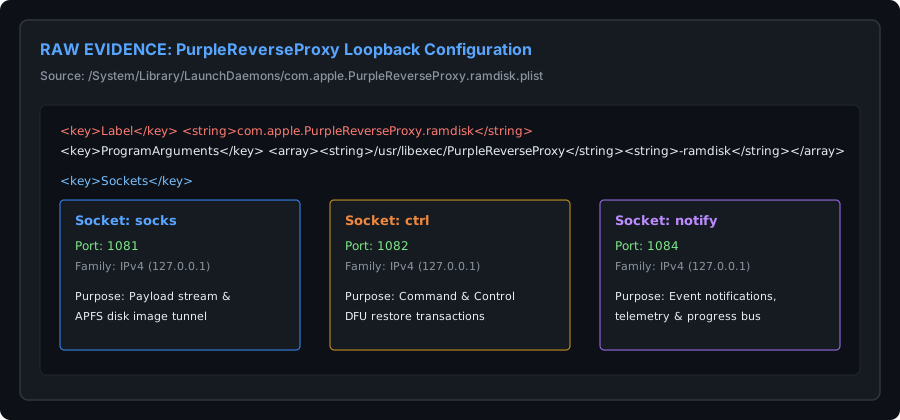
- Port 1081 (
socks): Binary data stream for incoming APFS disk images. - Port 1082 (
ctrl): Transactional command and control channel. - Port 1084 (
notify): Real-time progress reporting and event notifications.
The Apple Restore Engine (ramrod)
Link to section: The Apple Restore Engine (ramrod)ramrod (/usr/libexec/ramrod/ramrod) is a 2.0 MB Mach-O binary compiled with Apple LLVM (SDK macOS 12.6, deployment target macOS 11.0).
Pipeline Operations & Flags
Link to section: Pipeline Operations & Flags--restore # Standard full OS volume restoration
--restore+art # Restore OS and flash factory ART sensor calibration records
--erase # Complete disk erasure and partition reconstruction
--preflight # Pre-restoration integrity and hardware validation
--query # Interrogate device state and hardware revisions
--reset # Hardware controller soft reset
--validate # Cryptographic hash and manifest verification
--sendtunabletables # Dispatch hardware calibration tables to controllers
--stashExpectedFWVersion # Write expected firmware versions to NVRAM/PrebootPatch Plugin Routines
Link to section: Patch Plugin RoutinesDynamic routines provided by /usr/libexec/ramrod/plugins/ramrod-macos-patchd-plugin.ramrod:
patchd_macos_seal_system_volumepatchd_macos_fixup_prebootpatchd_macos_check_efi_featurespatchd_macos_set_bless_to_fail_backpatchd_macos_mount_all_filesystems_with_error
Raw Evidence: ramrod Pipeline Architecture
Link to section: Raw Evidence: ramrod Pipeline Architecture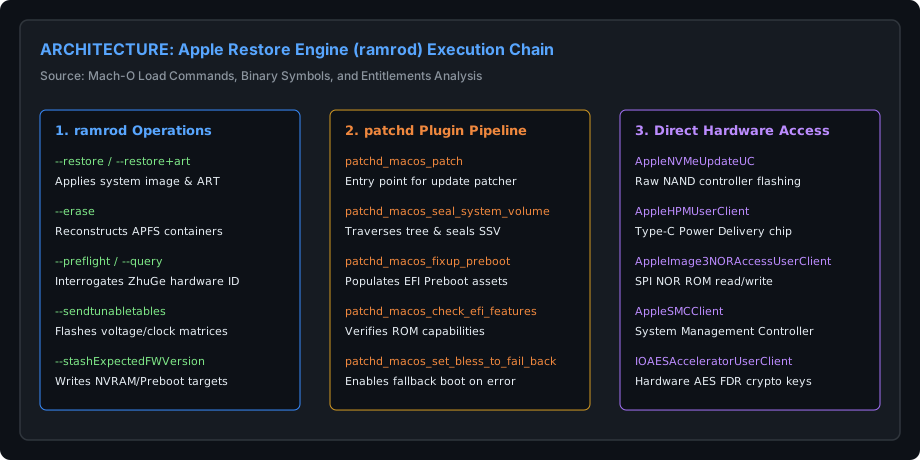
Binary Entitlements Manifest
Link to section: Binary Entitlements Manifestramrod possesses extensive kernel and hardware entitlements:
<!-- Storage Keys & Encryption -->
<key>com.apple.keystore.filevault</key><true/>
<key>com.apple.keystore.fdr-access</key><true/>
<key>com.apple.keystore.sik.access</key><true/>
<key>com.apple.private.security.bootpolicy</key><true/>
<key>com.apple.private.applesepmanager.allow</key><true/>

<!-- APFS Snapshot & SSV Capabilities -->
<key>com.apple.private.apfs.create-sealed-snapshot</key><true/>
<key>com.apple.private.apfs.revert-to-snapshot</key><true/>
<key>com.apple.private.apfs.set-firmlink</key><true/>

<!-- Direct IOKit UserClients -->
<key>com.apple.security.iokit-user-client-class</key>
<array>
    <string>AppleNVMePassThroughUC</string>
    <string>AppleNVMeUpdateUC</string>
    <string>AppleNVMeSMARTUserClient</string>
    <string>AppleImage3NORAccessUserClient</string>
    <string>AppleEmbeddedSimpleSPINORFlasherDriverUC</string>
    <string>AppleHPMUserClient</string>
    <string>AppleSMCClient</string>
    <string>IOThunderboltFamilyUserClient</string>
    <string>IOAESAcceleratorUserClient</string>
</array>
(Full entitlements catalog in docs/entitlements.md)
Kernel Collection (BootKernelExtensions.kc)
Link to section: Kernel Collection (BootKernelExtensions.kc)The image relies on /System/Library/KernelCollections/BootKernelExtensions.kc (65 MB x86_64 Mach-O prelinked kernel collection) containing 252 kernel extensions:
=== Core Storage & Disk Extensions ===
• com.apple.filesystems.apfs (v1934.141.2)
• com.apple.filesystems.hfs.kext (v583.100.10)
• com.apple.iokit.IOAHCIFamily (v333.140.2)
• com.apple.iokit.IOATAFamily (v2.5.3)
• com.apple.iokit.IOUSBMassStorageDriver (v210.120.3)
• com.apple.driver.DiskImages.RAMBackingStore (v493.0.0)

=== Security, SEP & T2 Coprocessor ===
• com.apple.driver.AppleKeyStore (v2)
• com.apple.driver.AppleSEPManager (v1.0.1)
• com.apple.driver.AppleCredentialManager (v1.0)
• com.apple.security.AppleImage4 (v4.2.0)
• com.apple.kext.CoreTrust (v1)

=== SMC & Power Management ===
• com.apple.driver.AppleSMC (v3.1.9)
• com.apple.driver.AppleSMCRTC (v1.0)
• com.apple.driver.AppleEffaceableStorage (v1.0)
• com.apple.driver.AppleEffaceableNOR (v1.0)

=== Thunderbolt & Bus Interconnect ===
• com.apple.iokit.IOThunderboltFamily (v9.3.3)
• com.apple.driver.AppleThunderboltNHI (v7.2.81)
• com.apple.driver.AppleThunderboltPCIAdapters (v4.0.1)
• com.apple.driver.AppleThunderboltUTDM (v3.0.7)
(Complete 252-kext manifest in docs/kext_inventory.md)
Hardware Firmware & Option ROM (OFW) Catalog
Link to section: Hardware Firmware & Option ROM (OFW) CatalogLocated in /usr/standalone/firmware/, the RAMDisk embeds binary microcode images for local offline flashing.
Raw Evidence: Firmware Flashing Matrix
Link to section: Raw Evidence: Firmware Flashing Matrix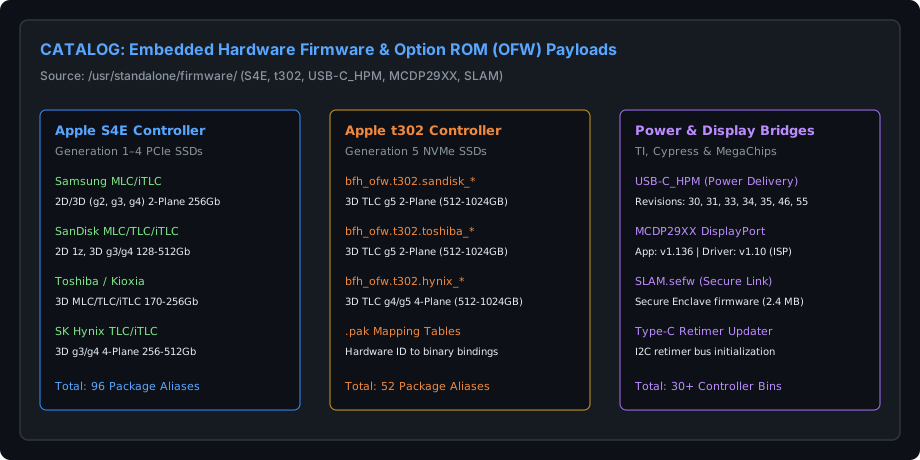
Apple S4E Controller Microcode (Gen 1–4)
Link to section: Apple S4E Controller Microcode (Gen 1–4)- Samsung:
s4e_ofw_samsung_mlc_3d_g2_2p_256.bin,s4e_ofw_samsung_mlc_3d_g3_2p_256.bin,s4e_ofw_samsung_itlc_3d_g4_2p_256.bin - SanDisk:
s4e_ofw_sandisk_mlc_2d_1z_4p_128.bin,s4e_ofw_sandisk_mlc_3d_g3_2p_170.bin,s4e_ofw_sandisk_tlc_3d_g3_2p_256.bin,s4e_ofw_sandisk_tlc_3d_g4_2p_512.bin - Toshiba / Kioxia:
s4e_ofw_toshiba_mlc_3d_g3_2p_170.bin,s4e_ofw_toshiba_tlc_3d_g3_2p_256.bin,s4e_ofw_toshiba_itlc_3d_g4_2p_256.bin - SK Hynix:
s4e_ofw_hynix_tlc_3d_g3_4p_512.bin,s4e_ofw_hynix_itlc_3d_g3_4p_256.bin,s4e_ofw_hynix_itlc_3d_g4_4p_512.bin
Apple t302 Controller Microcode (Gen 5)
Link to section: Apple t302 Controller Microcode (Gen 5)bfh_ofw.t302.ofw.sandisk_tlc_3d_g5_2p_512gb.bin/1024gb.binbfh_ofw.t302.ofw.toshiba_tlc_3d_g5_2p_512gb.bin/1024gb.binbfh_ofw.t302.ofw.hynix_tlc_3d_g4_4p_512gb.bin/1024gb.bin- Mapped dynamically via
.pakaliases matching board and chip IDs.
USB-C Power Delivery & High Performance Managers
Link to section: USB-C Power Delivery & High Performance ManagersUSB-C_HPM,30.bin/USB-C_HPM,31.binUSB-C_HPM,33-P01_P-AP.bin/USB-C_HPM,33-P2_P-DEV.binUSB-C_HPM,34-P01_P-AP.bin/USB-C_HPM,34-P5-AP.binUSB-C_HPM,35-P01-AP.bin/USB-C_HPM,35-P45-AP.binUSB-C_HPM,46-P01-AP.bin/USB-C_HPM,55.bin
Display Bridges & Secure Enclave
Link to section: Display Bridges & Secure Enclave- MegaChips DisplayPort Converter (
MCDP29XX):app(524 KB),isp(18.5 KB),versions.plist(App v1.136, Driver v1.10). - Secure Link Accessory Module (
SLAM):SLAM.sefwSecure Enclave firmware image (2.43 MB).
(Detailed package table in docs/firmware_catalog.md)
APFS Sealed System Volume (SSV) Toolchain
Link to section: APFS Sealed System Volume (SSV) ToolchainRaw Evidence: Merkle-Tree Sealing Sequence
Link to section: Raw Evidence: Merkle-Tree Sealing Sequence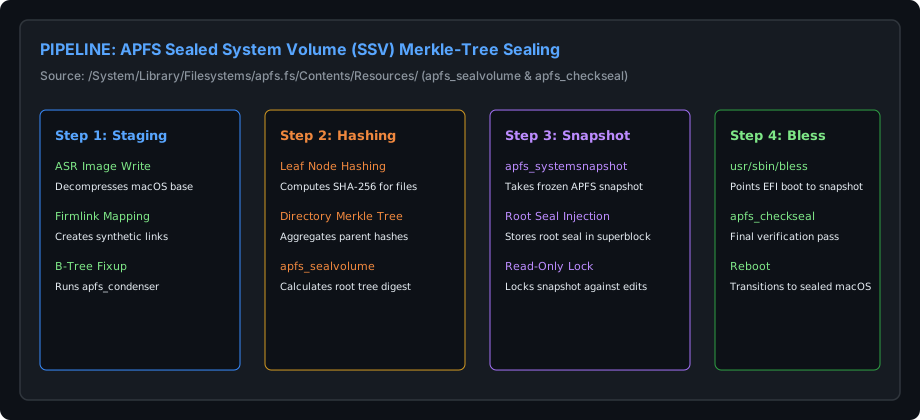
Low-Level APFS Maintenance Tools
Link to section: Low-Level APFS Maintenance ToolsLocated in /System/Library/Filesystems/apfs.fs/Contents/Resources/:
apfs_sealvolume: Traverses the filesystem tree, computes Merkle SHA-256 digests for all files/directories, and injects the cryptographic seal into the root snapshot superblock.apfs_checkseal: Validates whether the mounted system volume matches its signed seal.apfs_systemsnapshot: Creates and marks the active APFS system boot snapshot.apfs_invert: Performs extent-level inversion during update fallbacks.slurpAPFSMeta: Low-level diagnostic utility to dump APFS superblock and object map records.
USB Composite Emulation Profiles (USBDeviceConfiguration.plist)
Link to section: USB Composite Emulation Profiles (USBDeviceConfiguration.plist)Located in /System/Library/AppleUSBDevice/USBDeviceConfiguration.plist:
Raw Evidence: Composite USB Descriptors
Link to section: Raw Evidence: Composite USB Descriptors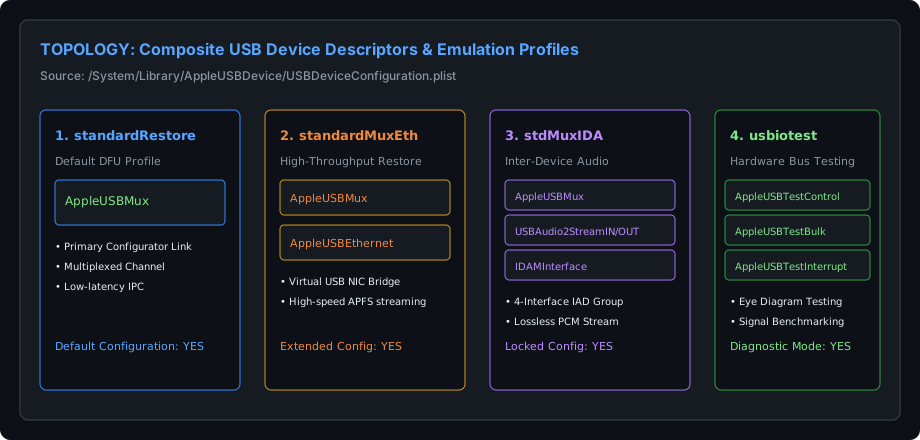
| Profile Name | Presented USB Interfaces | Operational Purpose |
|---|---|---|
standardRestore | AppleUSBMux | Base DFU restore & Apple Configurator link |
standardMuxEthernet | AppleUSBMux, AppleUSBEthernet | High-throughput virtual network imaging |
stdMuxIDA | AppleUSBMux, USBAudio2Control, IDAMInterface | Inter-Device Audio (IDA) pass-through |
standardMuxPTPEthernetValeria | AppleUSBMux, AppleUSBEthernet, Valeria | Studio Display camera/video calibration |
usbiotest | AppleUSBMux, AppleUSBTestControl/Bulk/Interrupt | Hardware USB bus electrical testing |
(Detailed interface breakdown in docs/usb_device_modes.md)
Feature Flags & Kernel Domain Toggles
Link to section: Feature Flags & Kernel Domain TogglesLocated in /System/Library/FeatureFlags/Domain/, over 85 property list domain manifests govern runtime feature activation:
- Networking & Transport:
CFNetwork.plist(QuicConnectionMigration,Http3Fallback),APS.plist(ShorterConnectDelayV1). - Media & Audio Routing:
AudioHAL.plist(Host_ASP_OoP),AVConference.plist(facetime_camera_sifr). - Security & Biometrics:
LocalAuthentication.plist(BiometricFailover),Security.plist(StrictTrustPolicy),XProtect.plist.
(Full domain manifest in docs/feature_flags.md)
Hardware Discovery & Private Frameworks
Link to section: Hardware Discovery & Private FrameworksZhuGeSupport.framework(ZhuGe-60.120.2): Apple's internal hardware querying framework (ZhuGeCopyValueWithError). Interrogates MLB serials, chip revisions, and NAND geometry before flashing.MFAAuthentication.framework: Hardware accessory and coprocessor cryptographic handshake framework.RemoteServiceDiscovery.framework&RemoteXPC.framework: Lightweight host-to-device remote procedure call subsystem.
Security, Image4 & FDR Trust Architecture
Link to section: Security, Image4 & FDR Trust ArchitectureDuring a DFU restore, the RAMDisk validates every firmware payload and system image against Apple's Image4 (IMG4) container specifications and Factory Data Recovery (FDR) manifests:
Raw Evidence: Image4 & FDR Trust Chain
Link to section: Raw Evidence: Image4 & FDR Trust Chain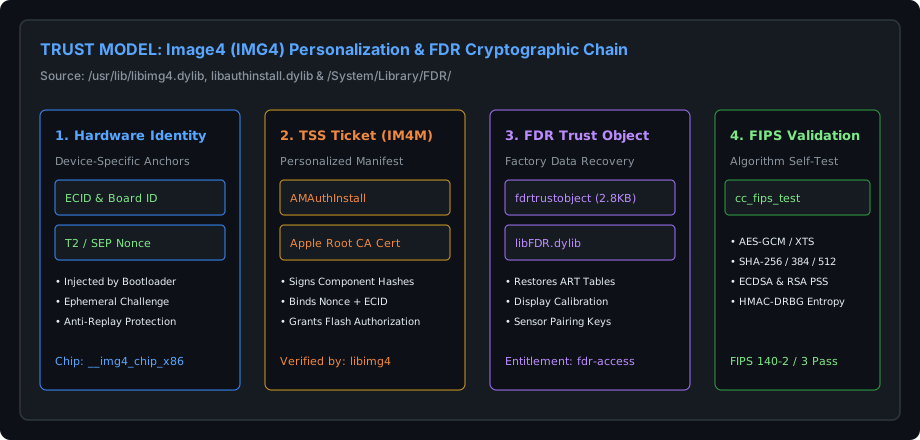
libimg4.dylib: Evaluates TSS tickets (IM4M) bound to the device's unique ECID and ephemeral T2 Nonce.libauthinstall.dylib: Manages personalization handshakes (AMAuthInstallApEnablePersonalization).System/Library/FDR/fdrtrustobject: Local cryptographic root anchor for restoring factory calibration (ART) records.
(Full security model in docs/security_trust_model.md)
dyld Linker & Runtime Architecture
Link to section: dyld Linker & Runtime ArchitectureUnlike standard macOS installations that rely on a multi-gigabyte monolithic dyld_shared_cache_x86_64, the RAMDisk operates with a stripped dynamic linker:
- Direct
.dylibLoading:/usr/lib/dyldresolves modular, unbundled shared libraries (154 individual.dylibfiles) directly in RAM. - Trampolines:
/usr/lib/libobjc-trampolines.dylibprovides fast runtime method dispatch (objc_msgSend) without cache dependencies. - Rosetta 2 Emulation Layer: Includes
/usr/lib/libRosetta.dyliband/usr/lib/liboah.dylibfor cross-architecture translation execution.
(Full runtime analysis in docs/dyld_and_runtime.md)
FIPS 140-2 Cryptographic Validation
Link to section: FIPS 140-2 Cryptographic ValidationBefore initiating disk imaging, the RAMDisk executes /usr/libexec/cc_fips_test to validate Known Answer Tests (KAT) for /usr/lib/system/libcorecrypto.dylib:
- Symmetric Encryption: AES-CBC, AES-GCM, AES-XTS (APFS encryption).
- Digest & MAC: SHA-256, SHA-384, SHA-512, HMAC-SHA256.
- Asymmetric Signatures: RSA PKCS#1 / PSS, ECDSA P-256 / P-384, HMAC-DRBG entropy generation.
(Full cryptographic suite details in docs/fips_cryptography.md)
Reproduction & Inspection Guide
Link to section: Reproduction & Inspection Guide1. Verify Image Checksum
Link to section: 1. Verify Image Checksum./scripts/verify_image.sh /path/to/StarSecurityRome21G115.x86_64SURamDisk.dmg2. Mount for Forensic Analysis
Link to section: 2. Mount for Forensic Analysis./scripts/mount_analysis.sh /path/to/StarSecurityRome21G115.x86_64SURamDisk.dmg /tmp/suramdisk3. Inspect Prelinked Kernel Extensions
Link to section: 3. Inspect Prelinked Kernel Extensionskmutil inspect -a x86_64 -B /tmp/suramdisk/System/Library/KernelCollections/BootKernelExtensions.kc --no-variant-extension4. Inspect Core Entitlements
Link to section: 4. Inspect Core Entitlementscodesign -d --entitlements :- /tmp/suramdisk/usr/libexec/ramrod/ramrod5. Safe Unmount
Link to section: 5. Safe Unmounthdiutil detach /tmp/suramdiskRepository Structure
Link to section: Repository StructureStarSecurity-SURamDisk/
├── README.md # Master forensic & architectural research paper
├── LICENSE # MIT License
├── SOURCES.md # Attribution & source provenance
├── evidence/ # Vector SVG architectural diagrams & raw evidence panels
│ ├── purplereverseproxy-sockets.svg
│ ├── ramrod-pipeline-architecture.svg
│ ├── firmware-flashing-matrix.svg
│ ├── apfs-merkle-sealing.svg
│ ├── usb-device-configurations.svg
│ └── image4-trust-model.svg
├── docs/ # In-depth technical specifications
│ ├── entitlements.md # Binary entitlements for ramrod, diskimagesiod, asr
│ ├── kext_inventory.md # Full 252 kernel extension manifest
│ ├── firmware_catalog.md # S4E, t302, USB-C HPM, and MCDP29XX Option ROMs
│ ├── apfs_toolchain.md # Deep dive into apfs_sealvolume, checkseal, slurpAPFSMeta
│ ├── usb_device_modes.md # Complete composite USB descriptor catalog
│ ├── feature_flags.md # 85+ FeatureFlags domain definitions
│ ├── security_trust_model.md # Image4 (IMG4) evaluation and FDR trust anchoring
│ ├── dyld_and_runtime.md # Modular dynamic loading and trampoline dispatch
│ └── fips_cryptography.md # CommonCrypto FIPS 140-2 validation suite
└── scripts/ # Analysis and verification scripts
├── verify_image.sh # Cryptographic hash validation tool
└── mount_analysis.sh # Safe read-only mounting scriptSecurity, Privacy & Responsible Research
Link to section: Security, Privacy & Responsible Research- Defensive Forensics: This project contains passive reverse-engineering and architectural documentation. It does not provide exploits, DRM circumvention tools, or activation bypasses.
- Clean-Room Verification: The analyzed RAMDisk image is a factory master artifact containing zero user directories (
/Users), personal keys, passwords, or runtime session logs. - Authentic Signatures: Every Mach-O executable in the image is digitally signed by the
Apple Code Signing Certification Authorityanchored to theApple Root CA.
Evidence, Provenance & Attribution
Link to section: Evidence, Provenance & Attribution- All findings and structures are verifiable through standard macOS command-line utilities (
hdiutil,kmutil,codesign,strings,plutil). - For complete upstream attribution and licensing boundaries, see SOURCES.md.
License & Legal Disclaimer
Link to section: License & Legal DisclaimerThe documentation, research findings, and verification scripts in this repository are licensed under the MIT License.
macOS, APFS, BridgeOS, T2, and Apple are registered trademarks of Apple Inc. All proprietary software and firmware identifiers discussed remain the intellectual property of Apple Inc.